
Brightli, Inc. names Indianapolis’s Tom Gaunt to Board of Directors

Brightli, Inc., parent company of Indianapolis-based Adult & Child Health, is pleased to announce the appointment of Tom Gaunt to its Board of Directors. Gaunt officially joined the board in April 2024, bringing a wealth of expertise from his service to Indianapolis and surrounding communities. A board member for A&C since 2010, Gaunt leaned on his lived experience as a foster parent and foster-child advocate to help guide the organization and was appointed board chair in 2018. He has provided Adult and Child Health with valuable insights from a foster parenting perspective and draws on his background in process management to contribute to the organization’s operations. Prior his involvement with Adult and Child Health, Gaunt had a successful career as the managing director of Geometric Solutions, a company specializing in adding value and reselling Siemens Engineering software. Gaunt studied mechanical engineering at Purdue University-Fort Wayne and Indianapolis. As a foster parent, Gaunt and his wife, Jean, adopted 11 foster children in addition to raising four children of their own. Overall the Gaunts provided care for more than 110 foster children with multiple disabilities, many of them A&C clients. “We are delighted to welcome Tom to the Brightli board,” said C.J. Davis, President and CEO of Brightli. “Tom’s dedication to foster children of Indianapolis is true mission in action. His service to A&C has been invaluable to that organizations growth and we are grateful that he has agreed to bring his passion and energy to the board of A&C’s parent company.”
National Foster Care Month: “Engaging Youth. Building Supports. Strengthening Opportunities.”
May is National Foster Care Month. This year’s National Foster Care Month theme, “Engaging Youth, Building Supports, Strengthening Opportunities” emphasizes the importance of a child welfare system that authentically engages and supports young people who are preparing to leave foster care. At Adult & Child Health— and nation-wide— we are urgently searching for foster parents willing to open their homes and act as mentors to older youth. Foster Parents as Youth Mentors Due to past trauma and system involvement, youth in foster care often struggle to trust adults. Foster parents have the ability to be stable and consistent people in youths’ lives. By showing unconditional care and support, setting boundaries, and allowing youth to have a voice in their own stories, they help youth to rebuild their trust in others. Many of A&C’s foster parents support youth from foster care well after they have “aged out” of the system. By providing long-lasting and permanent relationships with youth, these mentors help the youth cope with past trauma and learn how to heal. These relationships also provide a guide for what healthy relationships can look like for them in the future. Foster parents help youth with little to no family support access resources such as financial aid for college, resources for safe and stable housing, practice interviewing for jobs, and support and encouragement to make positive decisions that will help them achieve success in adulthood. Pursuing Permanency: Upstream Preventions In the context of child welfare, permanency means that a child has “a safe, stable and secure home and family, love, unconditional commitment, and lifelong support in the context of reunification, adoption, or legal guardianship.” The first step toward achieving permanency is ensuring that adults have the supports and services they need to care for the children in their lives. At Adult & Child Health, we know the value of the continuum of care that our staff are able to provide to our patients and clients. Our comprehensive, wide-ranging services touch the whole health journey, from prevention and outreach to treatment and management/enabling services. The ultimate goal of A&C’s services in regards to permanency would be to eliminate the need for a child to be removed from their home due to unsafe circumstances. The continuum of care is crucial in creating a safe, healthy, and care-free childhood for children in our communities. Service lines that don’t directly work with youth have the capability to positively impact adults, lifting them up and enabling them to care for the children in their lives in more effective and compassionate ways. Youth placed in A&C-licensed foster homes also have connections to the support our staff offer. Primary Prevention: Programs and services designed to promote the general welfare of children and families. Secondary Prevention: Services identified and provided to families who have identified risk factors for maltreatment. Tertiary Prevention: Services provided after the occurrence of abuse or neglect. These services are designed to prevent the recurrence of abuse. Most of Adult & Child Health’s services fall under primary prevention. It’s even described in our value statement: “We strive for caring communities, where every child, adult, and family have opportunities to live healthy, purposeful lives.” Our child welfare and wraparound teams play a large role in secondary prevention, with therapeutic foster care and behavioral health/therapy services stepping in to provide additional tertiary prevention. The ability to focus on upstream efforts to build stronger families is a major positive outcome of Adult & Child’s continuum of care. According to Prevent Child Abuse Indiana, “by focusing especially on primary prevention, we can help mitigate the necessity of the other two.” Fostering as a Community Support In cases where it is unsafe for a child to remain in their home of origin, a foster family steps in to provide appropriate care and a loving, temporary home. The foster family is connected to an array of resources to support themselves and the child, while the parent(s) of origin are also supported in taking steps toward reunification whenever possible. Permanency is vital for nurturing the safety and well-being of children and youth in foster care. Permanency might look like: Reunification with a child’s family Being placed with members of their extended family in guardianship or adoption Becoming members of new families through adoption As youth in foster care age, it is imperative to provide them with the supports they need to transition into adulthood. Many youth in the foster care system experience multiple episodes (removal from their home) of foster care. Many also experience multiple placement changes over an episode of foster care. This instability can lead to poor overall outcomes for the youth. In the state of Indiana in 2021, only 62% of youth who existed the foster care system were doing so due to permanency. According to a study done by the Annie E. Casey Foundation, youth who had faced foster care experienced higher rates of incarceration, unemployment, and young parenthood by the age of 21 compared to their peers who had not experienced the foster care system. They were also less likely to have health insurance, a high school diploma or GED, and stable housing. Studies show us that a person’s brain experiences a period of major growth and development from ages 14 to 25. Vital skills and tools like planning, decision-making, judgment, and coping skills are developed during this time. Adolescence is also a crucial time to counteract the harm that may have been caused by stressful and traumatic experiences in one’s youth. Exposing the adolescent brain to developmentally healthy experiences helps it “rewire” itself. Supportive, age-appropriate social services and resources— like many of those provided by the staff at Adult & Child Health— are instrumental in setting system-impacted youth on a path to a bright future. You can learn more about the roles of our staff who work with foster youth, including their insights and advice for parents and caregivers, through spotlight interviews with Sierra, Chris and Lindsay. If you’re interested in learning more about opening your home to youth in
Staff Spotlight: Sierra Morgan, Child Welfare Specialist
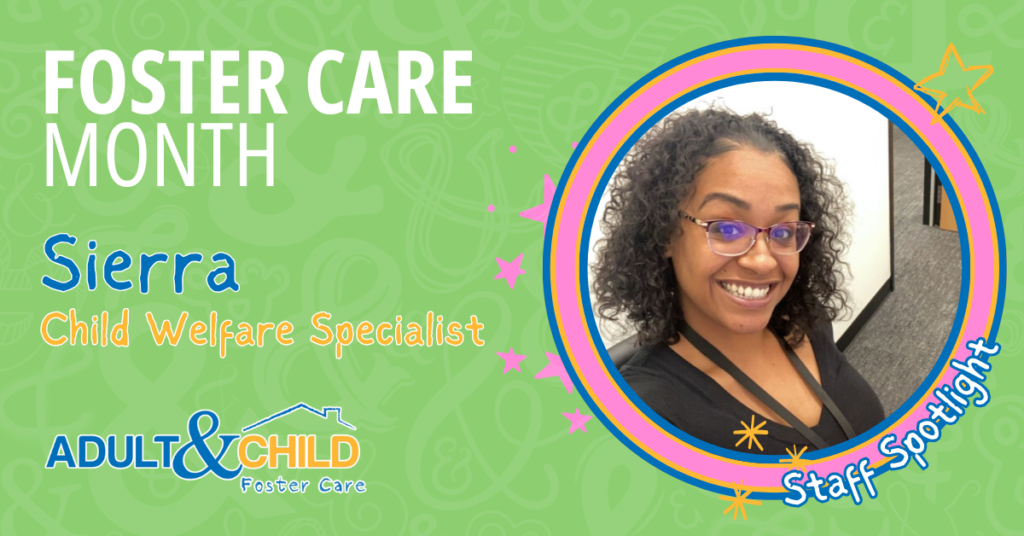
In honor of Foster Care Month, Sierra Morgan is sharing some insights on her role as a Child Welfare/ Independent Living Skill 14+ Specialist with Adult & Child Health. Read below to learn more about the motivation behind her work, some misconceptions she sees about foster care, and the challenges and rewards of working this field. Let’s get to know the child behind the adult! What is something you loved during your childhood? One of my favorite things as a child was to go to Michigan with my auntie. She would come and get my brother and I from our adopted home for all my school breaks. My aunt exposed me to optimism and faith in myself. What drew you to work in this field? I was a part of the foster care system as a child and was blessed to be adopted by my paternal grandmother. My aunt was a family case manager in the state of Michigan where I was adopted, I used to see all the work she did for kids like me and I wanted to be like her one day. As someone who works in child welfare, what is one message you’d like to give to parents and caretakers? Take things slow and one day at a time. Get done what you can with what you have and reach out for help if you need it. There are a lot of good people out there wanting to help and make a difference in the community and the hardest part is reaching out for that support. But I would like parents to know that it is out there! What are some misconceptions you think people have about foster care or about youth in the foster care system? The misconceptions would be that we try to break up families. The misconception that no one really cares about these kids and it’s just for a paycheck. In your opinion, what makes someone a good foster parent? A good foster parent is someone that takes time to care for the mental and emotional part of that youth. Being a parent is not easy but when an adult takes time to plant a seed, water the seed and grow it, that makes them a good parent. When your work gets particularly challenging or heavy, what keeps you moving forward? My faith in God keeps me moving, I know God is holding me and pushing me through some of my hardest times. I hold on to my faith because as a foster child myself that is all I had. My kids are my drive. I teach them no different than I would my fosters, and it feels good to my spirit. Do you have any favorite moments or success stories from your work that you can share? I have a client that wears a mask and hoodie all of the time, he has never taken it off for any other provider. On my fourth visit he removed his mask and allowed myself and his foster family to see his face. Is there anything else you want to share about foster care? Foster care changed my life; the services have come a long way from my time. I am truly blessed to be a part of something that others thought would have broken me. Here I stand with love in my heart, ready to give back to all my foster babies, reminding them anything is possible if you never give up. Learn more about how you can help Adult & Child Health provide a safe home for foster youth here.
Staff Spotlight: Chris Graham, Child Welfare Specialist
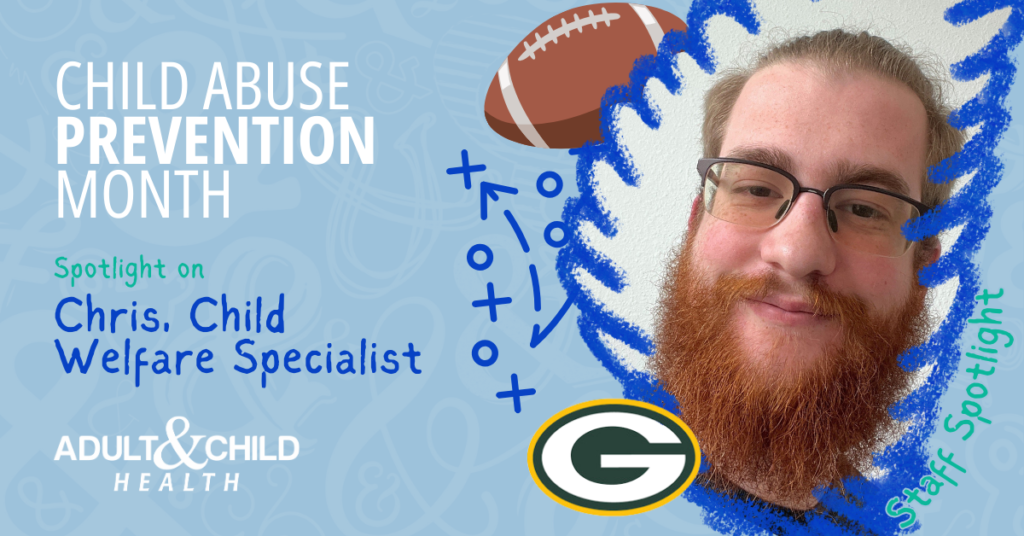
In honor of Child Abuse Prevention Month, Chris Graham is sharing some insights on his role as a Child Welfare Specialist with Adult & Child Health. Read below to learn more about how his work is improving the lives of local youth, the advice he has for parents and caregivers, and what keeps him moving forward during challenging times. Let’s get to know the child behind the adult! What is something you loved during your childhood? I was big into the NFL and still am to this day. I loved being able to watch football on the TV and became a fan of the Packers after the first game I watched where the Colts played them. In what ways do you see your work at A&C helping to improve the lives and safety of local youth? I see my work improving the lives of local youth by the rapport I am able to build with those I work with. Them having another person to trust and to talk to through different situations allows them to feel more comfortable and confident to handle situations that I have taught them or guided them how to do. As someone who works in child welfare, what is one message you’d like to give to parents and caretakers? One thing I want caregivers to know is that everything takes time and it won’t be a struggle forever. Sometimes what we think is easy isn’t so easy for others, it’s important to remember that any issue a child is going through takes time to learn, practice, and process how to get through the issue. When your work gets particularly challenging or heavy, what keeps you moving forward? What keeps me going is that even though we can have a terrible day and a bunch of bad things can happen in a week, there is always a success to celebrate. There is always someone who has achieved something that before in the past, others may have thought would not have been possible. What are some of your favorite moments or success stories from your work? A favorite moment of mine was watching my first adoption ceremony in court. It was touching to see how many people cared about my client and how happy they were to be adopted by the foster family they were with. Any final thoughts? Working in Child Welfare is hard and long work. It can be quite a journey to work with a client, but the reward of seeing them achieve a goal or finally use a skill that has been taught and see them realize the benefits they gain from using them is awesome. This is my first job working in this field. When I started, I didn’t think it would be something liked. It has turned out to be one of the most enjoyable jobs I’ve ever had the privilege of working in. The work we do to help children who have experienced abuse is so important and can change the outcomes of their future. Just thinking about that makes me want to ensure I provide them the best services I can possibly give. Learn more about the ways Adult & Child Health is involved in building safe and happy childhoods here.